
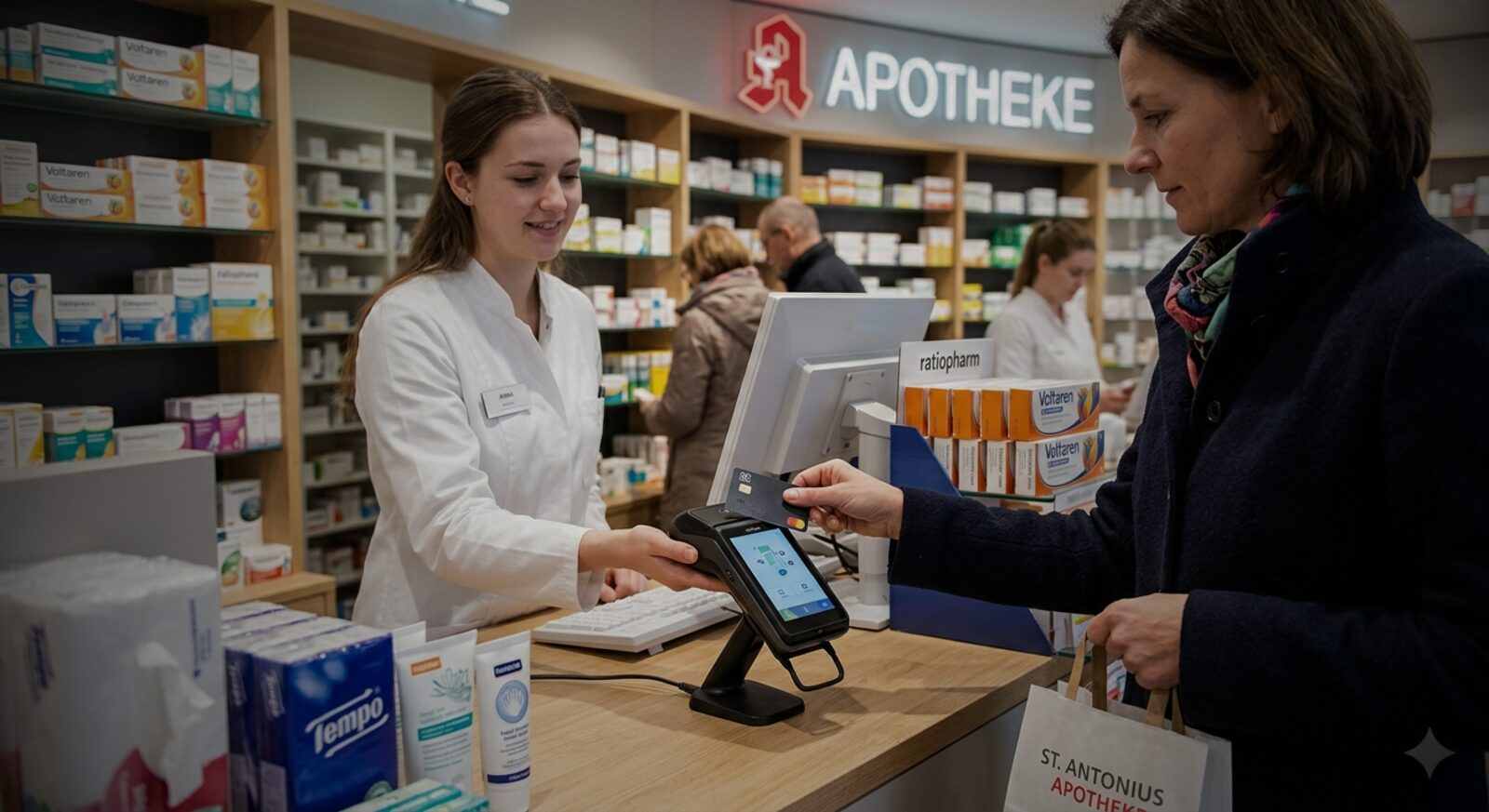
Monday, 8:30 a.m.: the e-prescription clears in seconds — and the copay gets keyed into the terminal by hand.
One e-prescription after another, copays of €5 and €10, counseling in between: at the dispensing counter, seconds decide how long the line gets. Just as quietly, your terminal’s fee structure decides how much of each copay actually stays in the pharmacy — because fixed transaction costs weigh far more at €5 than at €50. We compare all major providers, run the numbers on your real figures, and tell you where you are overpaying — free of charge and with no provider ties.
What makes the difference in your business
The percentage in the offer is not your price
0.25 percent sounds cheap — on a €5 copay, that would be 1.25 cents. But if the contract carries a minimum fee of 8 cents, you are effectively paying 1.6 percent: more than six times the advertised rate. With copays typically running €5 to €10 per prescription item, the pharmacy register is a small-ticket business — so what matters is never the percentage in the offer, but the effective rate at your average ticket.
A terminal that speaks IXOS and awinta
Since the e-prescription became mandatory, everything at the dispensing counter converges digitally anyway — except the terminal, which in some pharmacies still sits there as an island. Properly connected to pharmacy management systems like Pharmatechnik IXOS or awinta, it picks up the amount automatically: no retyping, no transposed digits, no discrepancies at the end-of-day close — TSE-compliant under Germany’s Cash Register Security Ordinance. In the contract negotiation, ask about the certified interface, not the device.
Downtime is not an option — a pharmacy is essential care
A retail store can, at a pinch, put customers off until tomorrow; someone picking up urgently needed medication shouldn’t be stopped by a failed card payment. Look for terminals with cellular fallback in case the landline goes down, and for contractually guaranteed repair and replacement times. Whether that clause says “next business day” or “a few hours” is decided in the fine print — not once the outage hits.
Delivery service: payment happens at the front door
Home delivery is part of everyday pharmacy business — open invoices and cash in the courier’s bag don’t have to be. A mobile terminal turns receivables into immediate liquidity: copay and add-on sale are settled at the front door and booked in your system. No chasing payments by phone, no unpaid receipts, no reconciliation work the next morning.
8.3 billion transactions with girocard (Germany’s debit card) in 2025, 88.5 percent of them contactless in December — the card has become standard even for a €5 copay. At the same time, the number of pharmacies fell to around 17,000 by the end of 2024, the lowest level since the 1980s. More card payments spread across fewer pharmacies: all the more reason to know exactly what every single transaction costs.
Send us your latest terminal statement and the name of your pharmacy management system. You’ll get a counter-calculation down to the cent: your current effective rate per transaction, your possible rate with other providers, and the difference projected over a full year — free, no obligation, and no sales calls.
Get your comparison